Germany's demographic disaster

Early on 13 August 1961, Berliners woke up to find their city divided. The East German regime was building the Berlin Wall in a desperate attempt to stop its people from leaving. Around 2.5 million had already done just that, since the foundation of the two German states in 1949. When the Wall fell peacefully in 1989, the exodus wasn’t supposed to resume. But it did, and on a devastating scale.
Sixty-five years on from when the wall went up, Germany’s eastern regions are trapped in a depopulation spiral. Nearly a quarter of former East Germans have moved west or abroad since German reunification. Most are young, well-educated and female. That’s left behind a region that is now Germany’s oldest, with its birth rate among the lowest, and with many of its communities watching schools, playgrounds, clubs and traditions slowly disappear.
While recognizing the scale of the demographic collapse, Germany’s established parties have tended to treat it as an economic issue, all while suggesting mass immigration as the answer: if you don’t have enough people, just import some. But Eastern voters don’t view demographic decline as a shortage of workers; they see the world they know disappearing, and they respond with pessimism. Mainstream politicians have ignored and even belittled this anxiety at their peril. Now, Right-wing populists are stepping into that void with spectacular success. The German East isn’t the only example of such dynamics, but it is a particularly stark one.
One thing that hit the East particularly hard was the speed of the change. When I was born in East Germany, in 1985, the birthrate was beginning to decline but was still above 1.7 children per woman. My family was pretty typical in having two children. In West Germany, the birthrate was already 1.3 — almost exactly what it is today across the reunified country. In what was formerly East Germany, though, it’s now just 1.2. In the eastern state of Saxony-Anhalt, where, in 1990, nearly 32,000 children were born, there were fewer than 12,000 new babies last year — the lowest number on record.
On 6 September, Saxony-Anhalt goes to the polls to elect a new state parliament, and the way the parties are addressing the demographic crisis couldn’t be more different. The state government is currently run by the center-right Christian Democrats (CDU), as it has been for most of the time since 1990. Their campaign focuses on the usual issues: jobs, crime, education, welfare, migration, healthcare. “Demographic change†is mentioned in the manifesto, but as a fact, something to be managed rather than addressed — let alone reversed. Voters seem unconvinced. Polls have the CDU at around 23% at the moment, down from 37% at the last election.
More from this author
The lesson of Weimar? Don’t ban the AfD
By contrast, the Alternative fĂźr Deutschland (AfD), whose Saxony-Anhalt branch has been classified by domestic intelligence as “Right-wing extremistâ€, is currently at 43%, very close to achieving an absolute majority of seats in the state parliament. They have come out hard on the issue of declining birthrates. Indeed, it’s the first item on their manifesto. “Germany suffers from massive depopulation,†they write in the first sentence of the first chapter. “What in political debate is referred to as ‘demographic change’ is nothing less than the aging and extinction of the German people.†The text goes on to claim that the “ruling parties†have known the extent of the problem for decades but are lacking “the political will or the courage to enact the measures that would be necessary to reverse the trendâ€.
The AfD’s language may be stark, but the party is not wrong to suggest that the established parties are deeply uncomfortable with the idea of discussing explicitly pro-natal politics. As with many other topics, debates around demography are fraught with uniquely German anxieties. The country where Nazis once pinned medals on the chests of particularly fertile mothers doesn’t want to be seen to be doing anything like it ever again.Â
Indeed, there was public outrage when the popular German news anchor Eva Herman started talking about it in 2007. Arguing in books and TV appearances that the German people was on the brink of extinction because feminism was eroding traditional family models and causing low birth rates, she referenced Nazi family policy. Hitler’s Germany, Herman claimed in a press conference, “was a cruel time”, one which ultimately led the country to its downfall. But, Herman added , “then we also abolished what was good, and that was values, children, mothers, families, solidarityâ€. Facing massive public criticism, and despite trying to back-track, Herman was fired from her job as a newsreader.
It was a lesson in what isn’t sayable in Germany around declining birth rates. All the same, today’s politicians and commentators would do well to take a closer look at Nazi pro-natalism: not to emulate it, but to see where ignoring the issue can lead if it’s left to extremists.
In the Twenties, too, many Germans were beset by demographic anxiety. Birth rates had plummeted from above four children per woman at the end of the 19th century to below replacement levels. The First World War had claimed the lives of around two million German men on the front lines, as well as hundreds of thousands of civilians. A smaller and continually shrinking population now worried over “empty cradlesâ€, an issue never explicitly addressed by a deeply fractured political class whose political bandwidth was eaten up by infighting and economic turmoil.Â
For the Nazis, though, pro-natalism was a central strand of their ideology. Their program attempted to increase the number of children through a mixture of propaganda, financial incentives and outright coercion. The most famous policy was the “Mother’s Crossâ€, a state decoration introduced in 1939 to honor German mothers with at least four children. Other policies aimed to drive women out of employment and into domesticity. In 1936, a Reich Central Office for Combating Homosexuality and Abortion was established to discourage acts that obstructed reproduction.
Over time, Nazi policies became more and more extreme. While forced sterilization programs and the outright murder of disabled people and ethnic minority groups aimed to limit the number of children the Nazi regime deemed undesirable, marriage loans and education for girls, that prepared them explicitly for future roles as mothers and housewives, were supposed to encourage the birth of more children for the German “People’s Communityâ€.Â
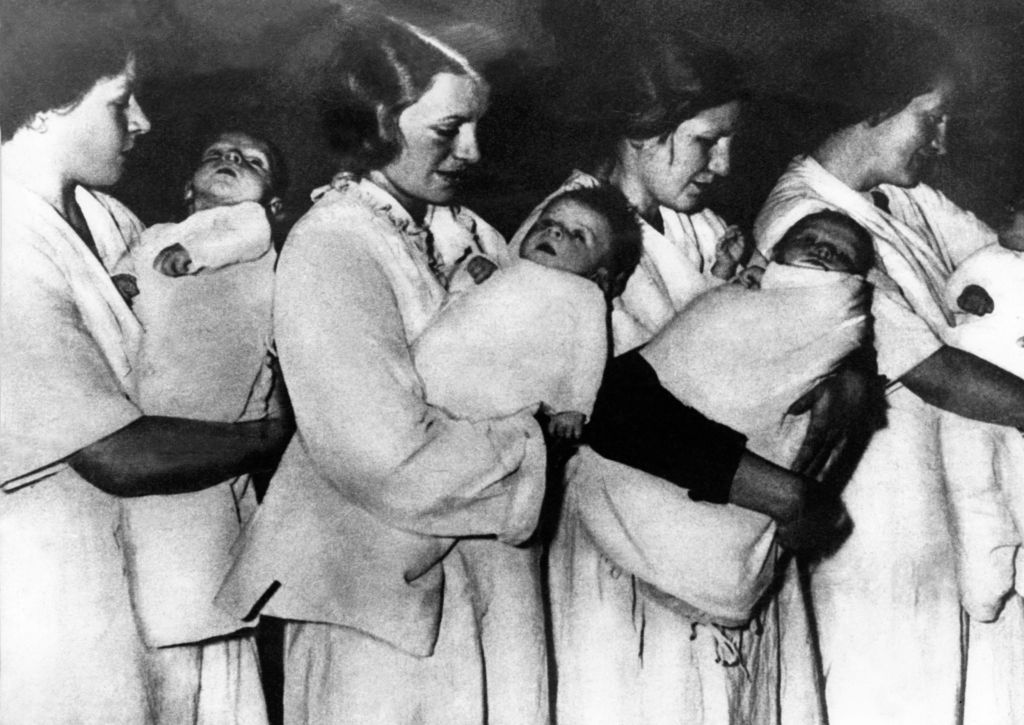
Meanwhile, the SS created the so-called Lebensborn program, originally established to support unmarried, pregnant “Aryan†women to have their children rather than seeking illegal abortions. During the war, the program radicalized and became involved in a number of increasingly bizarre and cruel practices, including the abduction of thousands of foreign children who happened to either be ethnically German or at least looked like they might be. Lebensborn claimed to “repatriate†these children by placing them in German families.
While the Nazis pursued demographic policies that involved state-orchestrated murder, the East German regime kept its existing population in the country at gunpoint. Given this historical backdrop, it’s hardly surprising that few German politicians today wish to discuss depopulation as something other than an unalterable fact. It’s much safer to think of people as workers or commodities, a view that allows the “topping up” of missing young people through immigration.Â
Indeed, that’s exactly how the refugee crisis of 2015, when Germany took in more than one million people, was framed. As the German Economic Institute wrote in 2016, “the immigration of refugees rejuvenates the German populationâ€. You still hear similar noises from regional governments a decade on.Â
And, certainly, most people I meet when I return to the former East Germany haven’t got a problem with controlled labor immigration — so long as the migrants integrate culturally and learn to speak German. But they don’t see it as an answer to depopulation. On the contrary: they see their children leaving and birthrates plummeting, even as the population of foreign nationals in Saxony-Anhalt has doubled since 2015. On average, the newcomers are 18 years younger than the local population, while a quarter of children born in Saxony-Anhalt in 2025 had a mother without German citizenship. This tends to fuel rather than alleviate anxieties of social and cultural change, whatever the established parties might claim.Â
The AfD, as a new party, only founded in 2013 and well used to being labeled as Nazi, has no qualms about suggesting pro-natal policies. Among other things, it wants to introduce a “Welcome†payment of â‚Ź2,000 for the first two children of a family, and then â‚Ź4,000 for each additional child if at least one parent is German. Abortion is to be discouraged and an ultrasound would be compulsory before an abortion is permitted.Â
 Suggested reading
How men screwed the birth rate
Suggested reading
How men screwed the birth rate
The AfD manifesto blames what it calls a “perverted Left-wing, radical feminist and individualist†spirit in German institutions, including schools, for the demographic collapse. “Rising abortion rates and declining birthrates,†the party claims, “are also connected to the fact that sexual deviances and non-reproductive lifestyles are now enjoying more acceptance and are more aggressively advocated than the normal family consisting of a man and a woman from which children are born.â€Â
“The primary aim of these policies is not to ensure a sufficient workforce for economic stability and growth but sustaining the German population as an ethnic and cultural entity.â€The primary aim of these policies is not to ensure a sufficient workforce for economic stability and growth: but sustaining the German population as an ethnic and cultural entity. Or, to quote analysis in Die Zeit, population decline is something “most parties view as a danger to the labor market and to pensions — the AfD senses a threat to the nation.†Most Germans, too, want less migration, especially of the unselective kind. Last year, a poll found that 68% of Germans want asylum numbers to go down, the highest such figure in a decade.Â
By emphasizing immigration while leaving Germany’s demographic anxiety entirely to the AfD, the mainstream parties are losing a lot of ground. And not just here: from Hungary to Poland, pro-natalism is largely a Right-wing populist concern. For the most part, of course, pro-natalism, doesn’t appear to work; the AfD may well prove to be unsuccessful with its efforts in Saxony-Anhalt, should it come to power there. Even the Nazis’ aggressive policies only increased the birth rate a little bit in peace time, before it plummeted again after 1939.Â
What to actually do about population decline amid changing lifestyles and gender roles remains a complex and ongoing question. But it is possible to acknowledge concerns and discuss the problem without slipping into the racialized or coercive politics of the past. If mainstream politicians refuse to find answers to that knotty demographic question, then the political margins will do it without them.Â
view comments