The Public News Choice
Vol. I · No. 284
Independent
Sixty-four countries already peaked. That is not extinction.
Our World in Data put the UN map on the table. X ran it as the end of the species. The paper does not say that.
The map that hit X on Sunday is real. The sermon built on top of it is not the same thing as the map.
Our World in Data published the piece on Aug. 17: Hannah Ritchie writing, Edouard Mathieu and Lucas Rodés-Guirao on the data. They used the United Nations World Population Prospects 2024 medium scenario. Their count: 64 countries and territories had already passed peak population in 2026. Almost all of them sit in Europe and East Asia. Japan and Italy peaked more than a decade ago. Thailand is on the list with fertility under 1.2. Uruguay is on it at 1.4. That is structural decline from low births, they write, not a war or a famine.
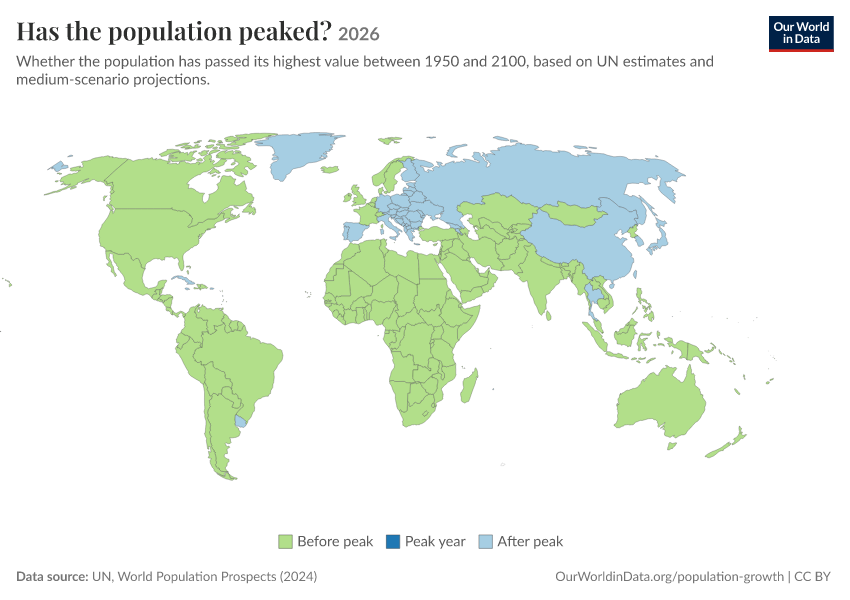
Crémieux posted the map Sunday morning: “It’s shocking, but several countries have already reached peak population and they’re now in decline.” vittorio quote-tweeted it and went further: 2026 “appears to be the first year in human history where humanity as a whole is below replacement fertility,” “the only real existential crisis.” Elon Musk quote-tweeted vittorio: “I’ve been warning about this for years.” Arthur MacWaters quote-tweeted Musk and wrote, “Unless rectified quickly, most of the US, Europe, and Asia will go extinct. This is a true existential risk,” over an Institute for Family Studies fertility-gap chart.
64 countries and territories had already passed peak population in 2026.
— Hannah Ritchie, Edouard Mathieu, and Lucas Rodés-Guirao, Our World in Data, Aug. 17, 2026, citing UN WPP 2024 medium projections
Here is the split this desk will not paper over. The UN’s own 2024 summary still puts the global fertility rate at 2.25 live births per woman, down from 3.31 in 1990, and projects the world hits 2.1 in the late 2040s. More than half of countries are already below replacement. The planet, in that revision, is not. vittorio’s “humanity as a whole” line is a claim. It is not what WPP 2024 printed. If someone has a newer UN table that crosses 2.1 in 2026, they can show it. This desk is not going to invent one so a quote-tweet lands.
Same with “extinct.” OWID says South Korea and China could more than halve by 2100 on the medium path. Italy could shrink more than 40 percent. Spain and Thailand, by a third. India is projected to peak in the 2060s. The United States, on that same map, never turns blue. Even in 2100 the UN medium path does not give the U.S. a peak, because it assumes enough immigration to offset low births. OWID’s own no-migration experiment: the U.S. would peak soon, shrink by 60 million by 2100, and sit 130 million below the with-migration path. That is a smaller country. It is not a vanished one. South Korea, they conclude, is close to locked in. The U.S. is an assumption about borders.
| Item | On the record |
|---|---|
| OWID / UN medium | 64 countries and territories past peak in 2026 |
| Global TFR in WPP 2024 | 2.25 births per woman; 2.1 projected late 2040s |
| U.S. on the medium map | No peak this century (immigration assumption) |
| U.S. if zero migration | Peak soon; −60 million by 2100 vs today; −130 million vs the with-migration path |
| X chain | Crémieux map → vittorio “first year” → Musk “years” → MacWaters “extinct” |
Low fertility is not a hoax, and it is not a cartoon. The operators on X are allowed to sound the alarm. The paper still has to print the UN number they skipped. Extinction is a word. 2.25 is a rate. They are not the same sentence.
Sources: Hannah Ritchie, Edouard Mathieu, Lucas Rodés-Guirao, “Which countries have already passed peak population…,” Our World in Data, Aug. 17, 2026 (CC BY 4.0); UN World Population Prospects 2024 Summary of Results (global TFR 2.25); X posts of Aug. 23, 2026 by @cremieuxrecueil, @IterIntellectus, @elonmusk, @ArthurMacwaters. Map: OWID / UN WPP 2024.
New York
publicnewschoice.com