Stepan Bandera is haunting the Ukraine War and Polish elections
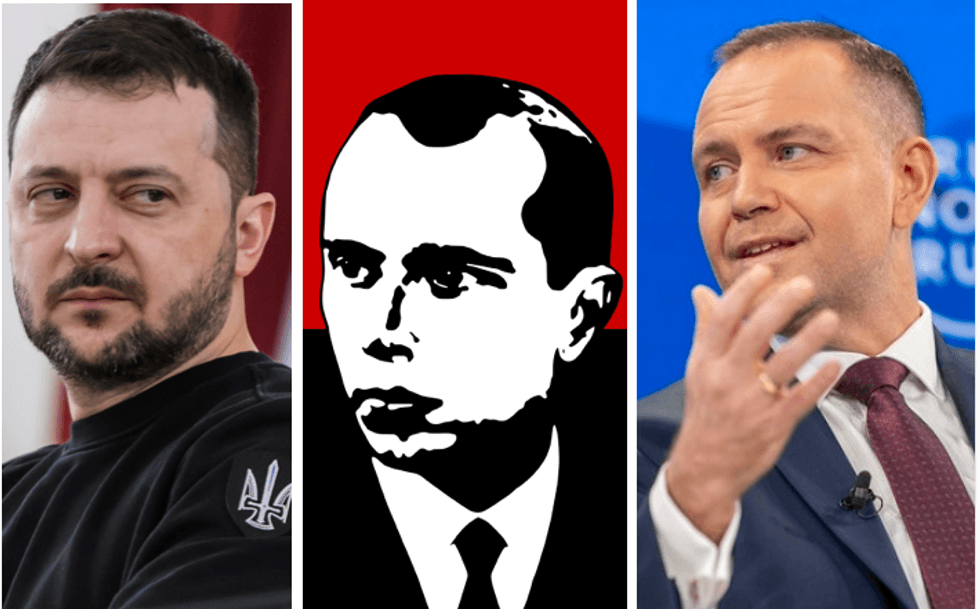
For the last several months, relations between Ukraine and Poland — one of Ukraine’s main supporters in its war with Russia — have been unusually strained.
The trigger for renewed mutual recriminations was the decision in June by Ukrainian president Volodymyr Zelensky to name a Ukrainian military unit after the “Heroes of the UPA,” which was the Ukrainian Insurgent Army, the armed wing of the Organization of Ukrainian Nationalists (OUN) during WWII.
Polish President Karol Nawrocki immediately reacted to this honoring of the OUN-UPA by revoking the Order of the White Eagle award — recognizing Polish-Ukrainian friendship — given to Zelensky by former President Andrej Duda in 2023.
Also this spring, Zelensky doubled down on Ukraine’s determination to honor WWII era nationalists by re-interring with military honors the repatriated remains of prominent OUN leader Andriy Melnyk. Zelensky announced plans to set up a pantheon in tribute to Ukraine’s national heroes. He said, “No one can tell us which heroes [Ukrainians] will honor.”
This controversy has implications for Polish support for Ukraine’s war effort. The populist-nationalist right opposition has, for example, challenged the decision by the centrist government to transfer a small number of Patriot interceptor missiles to Kyiv earlier this year, arguing that Poland’s own territorial defense should have priority.
The strain in Polish-Ukrainian relations will also feature in the effort of the Polish right as it seeks to defeat the centrist-left coalition in parliamentary elections to be held no later than October 2027 (they are not scheduled yet).
No doubt, Poland’s populist-nationalist right shares the widespread popular enmity toward Russia, but it prioritizes the country’s territorial defense over arming and sustaining Ukraine. From the standpoint of the right’s opposition to Prime Minister Tusk, the pursuit of historical justice for the Polish victims of the Volhynia massacres is necessary to reverse the alleged neglect of this tragedy by successive centrist governments. Those pragmatists stand accused of tactically forgetting the martyrdom of fellow Poles for the sake of a strategic alignment of Poland’s interests with those of Ukraine.
Wars over history: Volhynia
During WWII, the UPA fought the Soviet Army in the Galicia area of western Ukraine (then eastern Poland). Factions of the OUN-UPA also made early tactical accommodations with Nazi forces but the collaboration did not last. In 1943-45, UPA forces killed an estimated 100,000 Poles and members of other minorities in the Volhynia region, seeking to rid the area of Poles. In 2016, the Polish parliament designated the Volhynia massacre a genocide, declaring July 11 as an annual national observance of the events.
Ukraine contends that the OUN-UPA fought for the formation of an independent Ukraine, principally against the territorial ambitions of the USSR, but also of Poland and ultimately of Germany as well. They frame the Volhynia anti-Polish violence as “decolonization.”
UPA commander Stepan Bandera is anathemized in Israel, as well as in Poland and Russia, for mass killings of Jews in Kyiv and in eastern Poland/western Ukraine. Nevertheless, Ukrainian President Viktor Yushchenko declared him a national hero in 2010. A Ukrainian court annulled this designation in 2011, stating that hero status was reserved to citizens of the modern Ukrainian state. Bandera is still lionized by many Ukrainian right-wing nationalists.
In both Poland and Ukraine, state-supported Institutes of National Memory (IPNs) play a significant role in shaping public attitudes and have been led by nationalist populists. These institutes foster the uncritical assertion of national pride (“rising from one’s knees”) and refuse any acknowledgement of any blame under any circumstances. Nawrocki was president of the Polish Institute of National Memory from 2021 to 2025. A historian by training, he also led a revamping of the Gdansk WWII museum to emphasize exclusively Polish innocence and suffering.
Polish elections affected
The salience of the Volnynia massacre is greatest in Poland among supporters of the formerly governing PiS (Law and Justice) party and the two other populist nationalist parties (Konfederacja and Konfederacja of the Polish Crown). Despite the recent breakaway of the more moderate wing of PiS, on current trends, the right still has reasonable chances of being able to form a governing coalition.
The voters on the Polish right are also reflecting an impatience with the estimated 1.6 million Ukrainians who have taken refuge in Poland, a view that will serve the parties who represent these voters.
Meanwhile, the OUN-UPA controversy has practical implications for Ukraine’s accession into the EU, including from Tusk’s pro-EU centrist government. Recently, deputy prime minister and defense minister Kosiniak-Kamysz reiterated Poland’s insistence that Ukraine can not enter the EU “under the banner of Bandera.”
The politics of history will continue to roil relations between Poland and Ukraine, even if a cool assessment of national interest in both countries suggests this should not be the case.