The red telephone box can save Britain
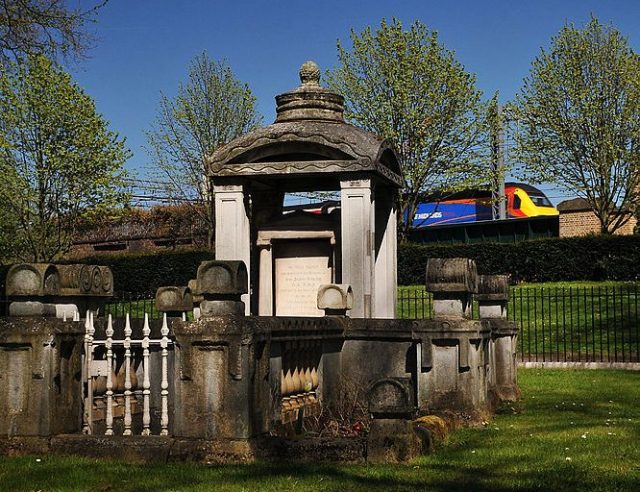
In the old St Pancras graveyard nestled behind King’s Cross, there is a tomb. Engraved with pineapples and an ouroboros, and crowned with a shallow dome, it is the resting place of Sir John Soane, the brilliant architect who designed the Bank of England headquarters. Soane designed it for his wife, who is said to have died of heartbreak in 1815 after their son traduced his father in the newspapers, before his own body was laid to rest there alongside hers.
Celebrating its 100th anniversary this year, the first K2 — or “Kiosk no.2†— was designed by another titan of British architecture, Giles Gilbert Scott. In his submission to a contest run by the Royal Fine Art Commission, Scott wanted to design a kiosk that used tradition to close the cultural rupture created by the telephone and networked modernity. A trustee of the Soane Museum, Scott borrowed the tomb’s distinctive neo-classical dome.
John Soane’s tomb: a familiar outline. (Photo by Jim Dyson/Getty Images)
The simple but elegant design, laid atop an industrial glass and iron box, gave birth to a form that is now iconic. Today, it is ubiquitous to Britain’s aesthetic in the national and global imagination. A century later, the society-rupturing technology of the day is artificial intelligence. Thoughtful observers might ask: can we once again create elegant and rooted aesthetic forms that encase cutting-edge technologies in ways that spark joy and connection?
Scott came from a family of great Victorian architects whose work attempted to tame technological upheaval. Techno-industrial revolutionaries had made Britain into the workshop of the world, sowing deep division in the process. Scott’s grandfather George attempted to temper the culture war by dressing modernity in Gothic revivalist architecture with a Christian face. The red brick façade of the hotel at St Pancras Railway Station, near Soane’s Tomb, typifies his approach. The hotel’s elaborate Gothic structure, echoing the cathedrals of yore, was designed as a counterbalance to William Henry Barlow’s epic iron-and-glass railway hall.
Decades later, in contrast to his grandfather’s Gothic shield against modernity, Giles took a different track. In an address to the Royal Institute for British Architects, Scott described his grand architectural theory of a “middle line†between the traditionalists and modernists. He said: “I want to see [Modernism’s] best features and characteristics retained and grafted at first onto the architecture of the past and then gradually developed.â€
Through this “middle lineâ€, the architectural historian Gavin Stamp argues, Scott found a compromise that gave his clients cutting-edge aesthetics while also building with traditional forms and materials to blend into the fabric of the built environment. Another critic, David Frazer Lewis, compares Scott’s philosophy to G.K. Chesterton’s theory that Christianity resolved its furious tensions by allowing “two opposite flames burning brightlyâ€. By creating designs that could be everything at once, Lewis argues, Scott seamlessly synthesized the modern, traditional, abstract, and archaeological into a new vision of the future.

The K2 is the perfect embodiment of Scott’s middle line. The Soane-inspired dome is formed by a vaulted roof cut from a hemisphere. Its four sides are gently ornamented with striking reeded strips above and fluted architraves below. These border a shallow inner patera which houses the “TELEPHONE†sign. The body features a grid of cast iron with rows of small panes of glass — which magically code as both Victorian factory and Georgian sash windows.
Rather than replicate the grandeur of Soane’s neo-classical embellishments, Scott avoided ornament that could be broken off. Instead, he delicately perforated holes in the shape of the King’s crown, simultaneously creating a ventilation system. The red paint, meanwhile, was not Scott’s choice. While he suggested silver with green interiors, the Post Office chose red to align with their post boxes.
Manufactured at various ironworks across Falkirk and Kirkintilloch, the K2 proliferated around London as demand for telephones skyrocketed. For King George V’s Jubilee in 1935, Scott was recalled to re-design a later iteration, the smaller K6 kiosk. Seeking evolution over revolution, he simplified the detailing and windows further and the K6 spread to the rest of the nation. When Scott died in 1960, there were 60,000 kiosks dotted across the country.
In the century following the K2 boom, the kiosks have been on something of a journey. While the K6, standing a little shorter with a wider central window pane, was a great success, the rise of domestic and then mobile phones gradually rendered them useless. The box’s successors, such as British Telecom’s hideous KX design, were loathed by the public. BT attempted to reimagine them as a “Street Hub†WiFi network, but campaigners are nevertheless trying to root them out of the nation’s pavements.
Yet many of Scott’s kiosks are still in rude health. Nearly three thousand are now listed monuments of national heritage, and many have taken on new lives. They are homes for defibrillators, mini libraries, cafÊs, public art works, smartphone repair shops, a pub, the world’s smallest nightclub — the possibilities are endless. The dividend for investing in timelessness is a return that compounds through each reinvention.
How has the K2 endured, despite its technological obsolescence? To a more trad-inclined critic, the kiosk’s success is evidence of the Scrutonian adage that if you “put beauty first, what you do will be useful forever. It turns out nothing is more useful than the useless.â€Â Yet the K2 has survived not simply because it’s a pretty red box. Countless other beautiful constructions have failed to stand the test of time.
There are deeper forces sustaining the K2, even if the kiosk’s power to unite a nation is somewhat paradoxical. The telephone connected the Edwardians to those far away, but it also had the potential to detach them from our physical world, thus beginning the atomization that has since been accelerated by the mobile phone. Like all technology, the telephone was not a neutral tool. It detached live voice from an in-person body, rendering it instead as sound that could come from any corner of the globe. Suddenly, as if by magic, one was free to connect to others miles away, but also to disconnect from one’s immediate world.
In his 1985 classic No Sense of Place, Joshua Meyrowitz fuses the media theory of Marshall McLuhan with Erving Goffman’s sociology of face-to-face behavior to explain how electronic media warp our sense of place. Meyrowitz argues that the ancient bond between where you are and how you experience the world is severed by electronic communications. For all of human history, physical place has governed what you knew and how you behaved with those around you. This “situational geographyâ€, as Meyrowitz calls it, dictates the norms and possibilities of a given place. A courtroom makes you behave formally, a pub is convivial, and a church could make you reverent.
Electronic media like telephones do strange things to that experience. Once information can fly in from elsewhere, the physical boundaries that guide behavior start to melt. With a phone or the internet, one could be in church while also being in a warzone or at a football match. This renders us, Meyrowitz argues, “more informed but less rootedâ€. Indeed it can happen to a nation as well as an individual. On a grand scale, the complex web of institutions held together by language, custom and print media could start to dissolve.
Rather than accelerate this dissolution, the K2 delayed it. What could have been an avatar of placelessness instead became a shared source of national unity, one that drew on and refashioned a common, recognizable, and rooted vernacular. A century later, wherever one is in Britain, the K2 — along with post boxes, hedgerows, and drystone walls — is the ultimate reminder that one is somewhere, not nowhere.
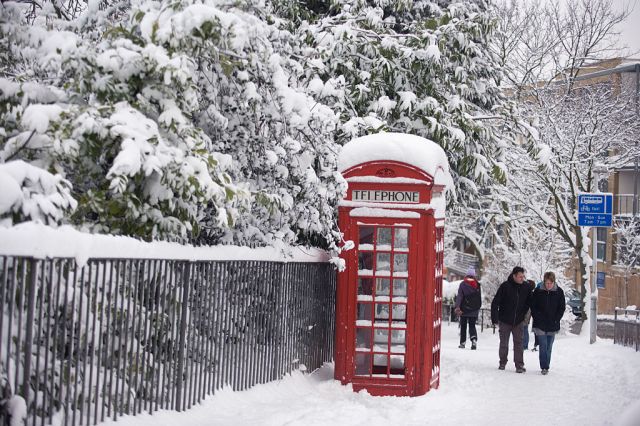
- Red telephone boxes immediately mark a scene as British. (Richard Baker/In Pictures Ltd/Corbis via Getty Images)
Today we stand at a similar crossroads. This time it is artificial intelligence that threatens the further erasure of our sense of place. Information is no longer located in just physical (or virtual) paper, books, places, or people. Rather, it now floods out from a chatbot in streams of text seemingly from everywhere and nowhere.
A skeptical public increasingly sees AI as a parasitical amorphous intelligence, poised to strangle them with surveillance, job losses, even techno-apocalypse. Once again, some companies seeking AI proliferation are invoking vague noises about “culture†and “taste†to prime consumers to welcome their technologies.
Yet, electronic media’s form has shape-shifted in the last century. Mobile computing has pushed physical infrastructure mostly out of sight — though backlash against ugly data centers has sparked the AI Minister, Kanishka Narayan, to incentivize architects to dream bigger. His glitzy new data center design prize might encourage more humane design.
Data centers, of course, are rarely our most direct physical experience of the digital age. The smartphone has become the primary human interface for computing — but that might not last. In June, Paul Graham, the founder of the legendary Silicon Valley startup accelerator Y-Combinator, observed: “No one knows yet what the next form factor for computing will be, and yet there will be a next form factor, and it will seem obvious in retrospect.â€
Some candidates are beginning to emerge. Meta is starting with eyeglasses, tapping into fashion culture by borrowing the valor of Ray-Ban and Oakley’s iconic designs and partnering with Kylie Jenner. Buying iconicity may temporarily work, but has borrowed valor ever endured? OpenAI, meanwhile, is betting on earbuds, hiring the iPhone-designing superstar Sir Jony Ive to build Dime. A recent stealth advert suggests the buds will live in a steel case resembling a space-age Anish Kapoor sculpture. In its deliberately futuristic design, the case oozes a familiar, clean rootlessness that may no longer inspire jaded consumers in the way early iPhones did. Meta and OpenAI are big enough companies that their new products will sell well. But whether those products will become timeless is doubtful.

Back in London, the voice AI firm ElevenLabs is taking Scott’s wisdom very literally. Rather than chase modernity, the startup is experimenting with a tried and tested model: the K2 telephone box itself. By training an AI mimicking Sir Michael Caine’s voice, then embedding it in an old-style phone within a replica K2, Eleven Labs has won hearts, minds, and eyeballs. Paying tribute to Scott’s great aesthetic innovation is a welcome act, if not quite the same as doing the painstaking work required to become the true heirs to his “middle lineâ€.
Instead, it is perhaps a small Swedish design studio that could one day prove Scott’s heir. Founded in 2005, Teenage Engineering makes musical synthesizers. They constantly play with form and function, rooting new devices in culture and history. Their medieval “Instrumentalis Electronicum†weds medieval design to the warm functionalism of Dieter Rams, while the Riddim ‘n’ Ting sampler plays with Jamaican dancehall aesthetics. The firm has since branched into wooden doll choirs and reinvented the Polaroid. Teenage Engineering’s cult following won them the job of co-designing Rabbit’s R1, a toy-like, AI-native computer styled after Eighties gaming. The R1 flopped, since it arrived too early for the AI boom and its Eighties-style plastic gave the appearance of cheapness. Yet the firm’s restless thirst for combining experimentation with roots shows how one can keep the best of modern design while borrowing the beloved ideas of the past. This could well lead Teenage Engineering to Scott’s promised land.
A hundred years on, the battles over the aesthetics of modern life rage on: glass towers versus Georgian townhouses, tailored versus sprayed-on suits, serif versus sans serif fonts. The argument will never stop. Yet the true heir to Scott will neither pick a side nor lazily approximate a middle ground. The harmony at the heart of the K2 comes from a delicate thoughtfulness, a commitment to crafting something that shields us from the rupturing force of technology, while also rooting us in a shared story. Those roots might come from a local vernacular, or simply from an earlier, less inhumane era of computing. For now, Scott’s throne is there for the taking.
view comments